1. The Beijing 2008 Watershed: Why Electronic Scoring Became Inevitable
Before the London 2012 Olympic Games, competitive Taekwondo scoring relied entirely on human perception. Four corner judges held handheld push-button clickers. A point was recorded only if at least three judges pressed the button within a strict 0.5-second time window.
In an elite Olympic match where foot speeds frequently exceed 18.5 meters per second (66.6 km/h), human optical reaction time (averaging 250–350 milliseconds) proved catastrophically insufficient. Judging disputes, national federation protests, and subjective bias threatened the Olympic status of the sport. World Taekwondo (WT) recognized that to survive on the global stage, scoring had to be automated through undeniable, objective physical measurement: the Protective Scoring System (PSS).
Generational Evolution of PSS Hardware
| Generation / Era | Primary Technology | Point Latency | False Positive Rate | Limitation / Vulnerability |
|---|---|---|---|---|
| Pre-2012 Manual | 4 Corner Human Clickers | 650 – 950 ms | 18.6% (Unseen Valid Hits) | Human visual blind spots & subjective delay |
| Gen 1 PSS (London 2012) | Magnetic Reed + Basic Foam | 85 – 120 ms | 8.2% | Instep magnet grazing scored without kinetic force |
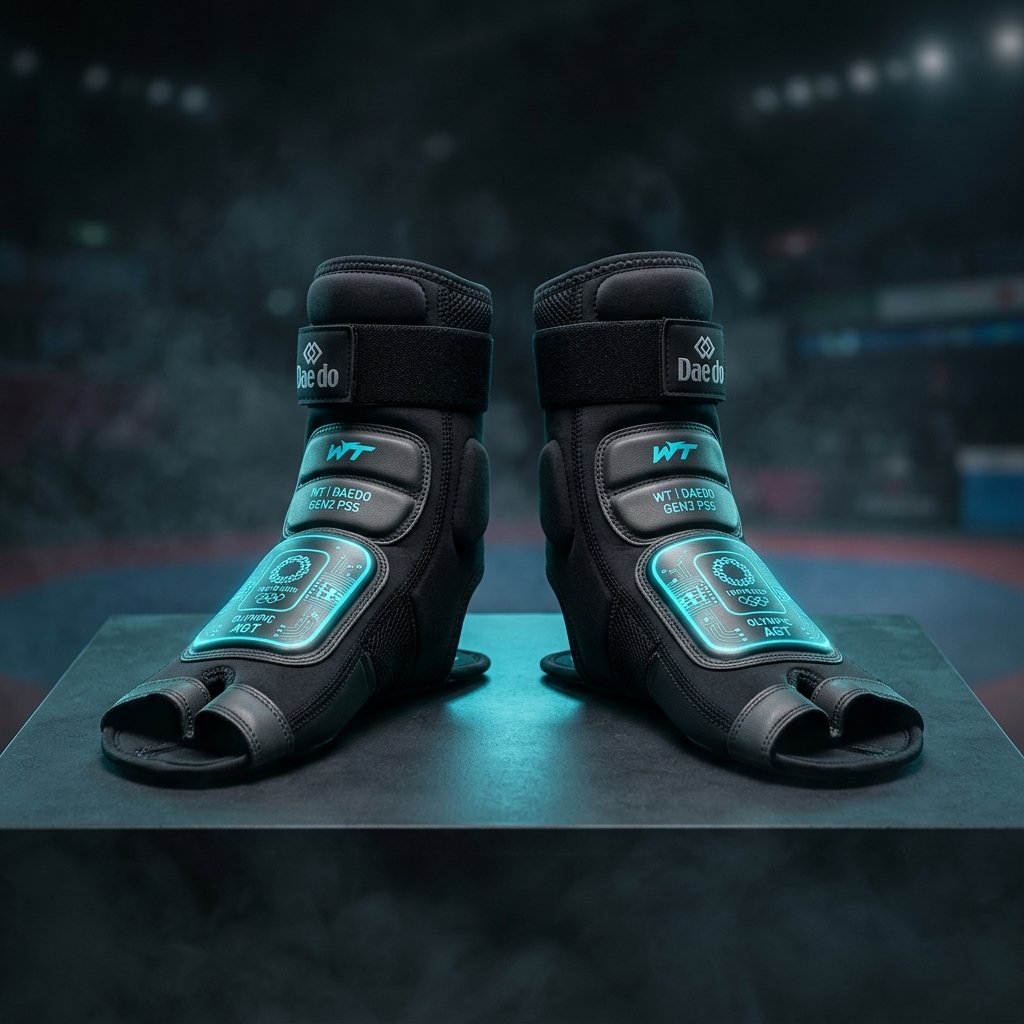
| Gen 2 PSS (Rio 2016 / Tokyo 2020) | Piezoelectric Force + RFID Sensors | 35 – 45 ms | 2.4% | "Monkey kicks" from extreme non-traditional angles |
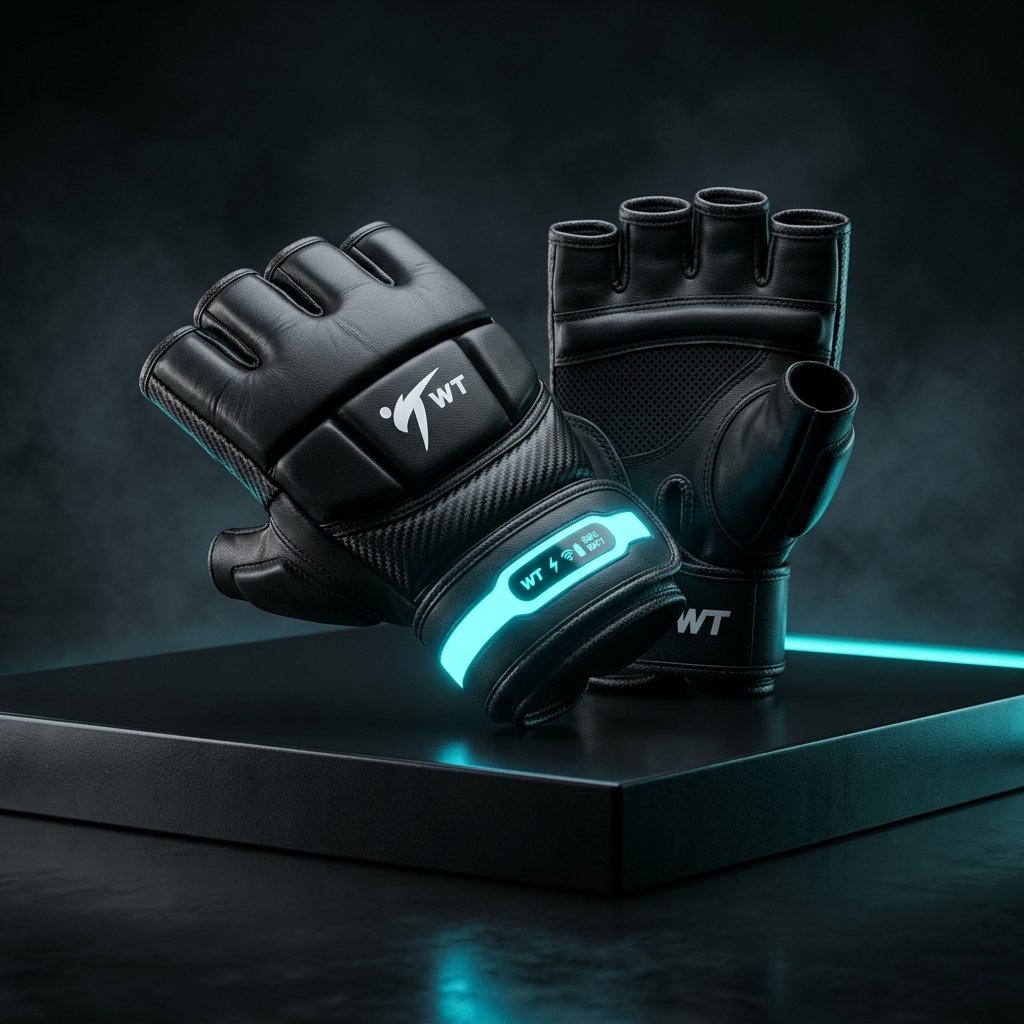
| Gen 3 / TaekFlow (2026) | Multi-Axis Accelerometer + IoT Telemetry | < 12 ms | < 0.6% | Fully resolves directional velocity & true impact vector |
2. Anatomy of Modern PSS: Two-Factor Impact Verification
Modern World Taekwondo competition rules require a dual-condition verification protocol before a point is registered on the arena scoreboard:
- Proximity / Surface Identification: The striking extremity (instep, bottom of heel, or knuckles of the glove) must carry calibrated proximity or magnetic sensors that align with the target zone of the chest guard (hogu) or headgear.
- Kinetic Force Threshold Dissipation (F ≥ F_threshold): The hit must deliver an impact force exceeding the weight-class specific threshold measured in Newtons ($N$).
If an athlete strikes with immense force using an unprotected shin or knee, the proximity sensor condition fails and zero points are awarded. Conversely, if an athlete gently taps the hogu with the magnetized foot sock without sufficient kinetic force, the piezoelectric pressure transducers fail to reach the threshold, and no point is registered.
"The implementation of electronic PSS transformed Taekwondo from a subjective art of stylistic perception into an exact athletic science of velocity, trajectory optimization, and impact dissipation." — Master Kyung-Soo Park, 8th Dan Kukkiwon
3. Weight Class Calibrated Impact Thresholds
A lightweight fighter cannot generate the raw kinetic momentum of an Olympic heavyweight. World Taekwondo rules mandate calibrated threshold levels programmatically loaded into the match software prior to each bout:
- Men -58 kg (Flyweight): 1,200 Newtons threshold ($~122 ext{ kg-force}$)
- Men -68 kg (Featherweight): 1,500 Newtons threshold ($~153 ext{ kg-force}$)
- Men -80 kg (Welterweight): 1,850 Newtons threshold ($~188 ext{ kg-force}$)
- Men +80 kg (Heavyweight): 2,400 Newtons threshold ($~245 ext{ kg-force}$)
- Women -49 kg: 950 Newtons threshold ($~97 ext{ kg-force}$)
- Women -67 kg: 1,400 Newtons threshold ($~143 ext{ kg-force}$)
4. The Next Frontier: Computer Vision & Real-Time Telemetry
While current electronic hogu and e-foot protectors have eliminated 95% of scoring controversies, the next generation of combat analytics—pioneered by the TaekFlow Platform—pairs wearable hardware with multi-camera computer vision.
By tracking joint angles in real time through spatial markerless motion capture, TaekFlow calculates not only whether the kick scored, but the precise chamber angle, hip rotational velocity, and energy transfer efficiency of the athlete.
Equip Your Dojang With Certified Telemetry
Train with the same sensor precision used on the world championship circuit.