1. The Kinetic Chain: How Taekwondo Multiplies Velocity
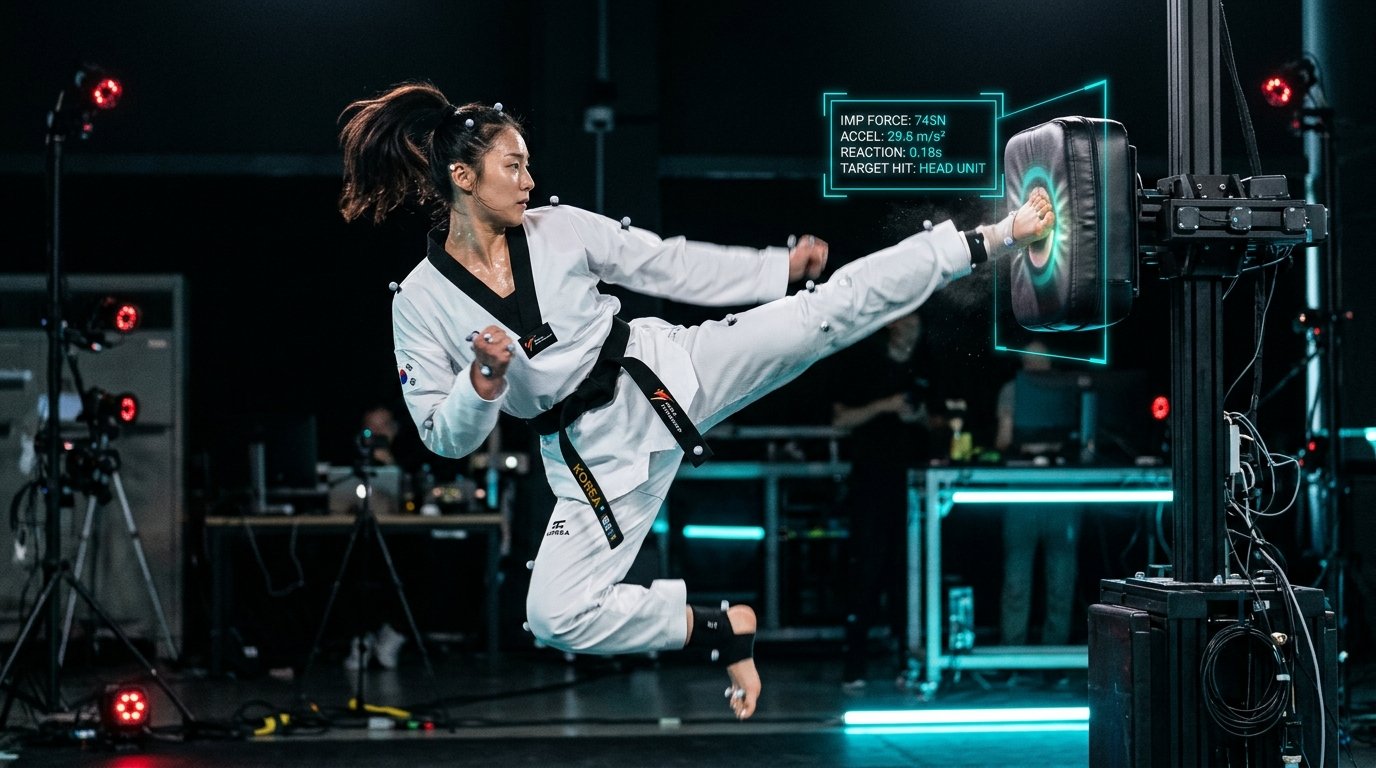
In human movement science, maximum strike power is governed by the summation of angular velocities through sequential body segments. A novice kicks using only their quadriceps and knee extension. An elite World Taekwondo competitor initiates force from ground reaction forces through the plantar flexors, channels pelvic rotation through the hip abductors, stabilizes the core musculature, and snaps the lower limb in a classic whip action (kinetic whip effect).
Because kinetic energy scales with the square of velocity:
Ek = ½ · m · v2
Doubling body mass ($m$) merely doubles kinetic impact energy, whereas doubling terminal strike velocity ($v$) quadruples the delivered energy ($4 imes$). This fundamental law of classical mechanics explains why lightweight Taekwondo fighters deliver devastating knockouts while maintaining incredible agility and aerobic endurance.
2. Empirical Strike Telemetry Benchmark Matrix
The following benchmark values represent averaged laboratory measurements recorded with high-frequency 1,000 Hz piezo force plates and high-speed multi-camera optical tracking:
| Strike Technique (Korean) | Peak Velocity | Peak Impact Force | Execution Time | Primary Mechanical Advantage |
|---|---|---|---|---|
| Bandal Chagi (Roundhouse) | 18.2 m/s (65.5 km/h) | 1,850 N (~188 kgf) | 0.18 sec | Shortest rotational arc, high scoring versatility |
| Twimyeo Dwi Chagi (Back Kick) | 15.6 m/s (56.1 km/h) | 2,850 N (~290 kgf) | 0.28 sec | Direct linear heel drive with total body mass transfer |
| Dwi Huryeo Chagi (Spinning Hook) | 22.4 m/s (80.6 km/h) | 2,100 N (~214 kgf) | 0.32 sec | Longest lever arm & highest angular velocity tip speed |
| Naeryeo Chagi (Axe Kick) | 14.8 m/s (53.3 km/h) | 2,300 N (~234 kgf) | 0.26 sec | Gravitational acceleration assisting downward hamstring snap |
| Mireo Chagi (Cut / Push Kick) | 12.5 m/s (45.0 km/h) | 1,450 N (~148 kgf) | 0.14 sec | Immediate chamber release, optimal defensive counter |
3. Sensor Telemetry & The PSS Target Engagement Window
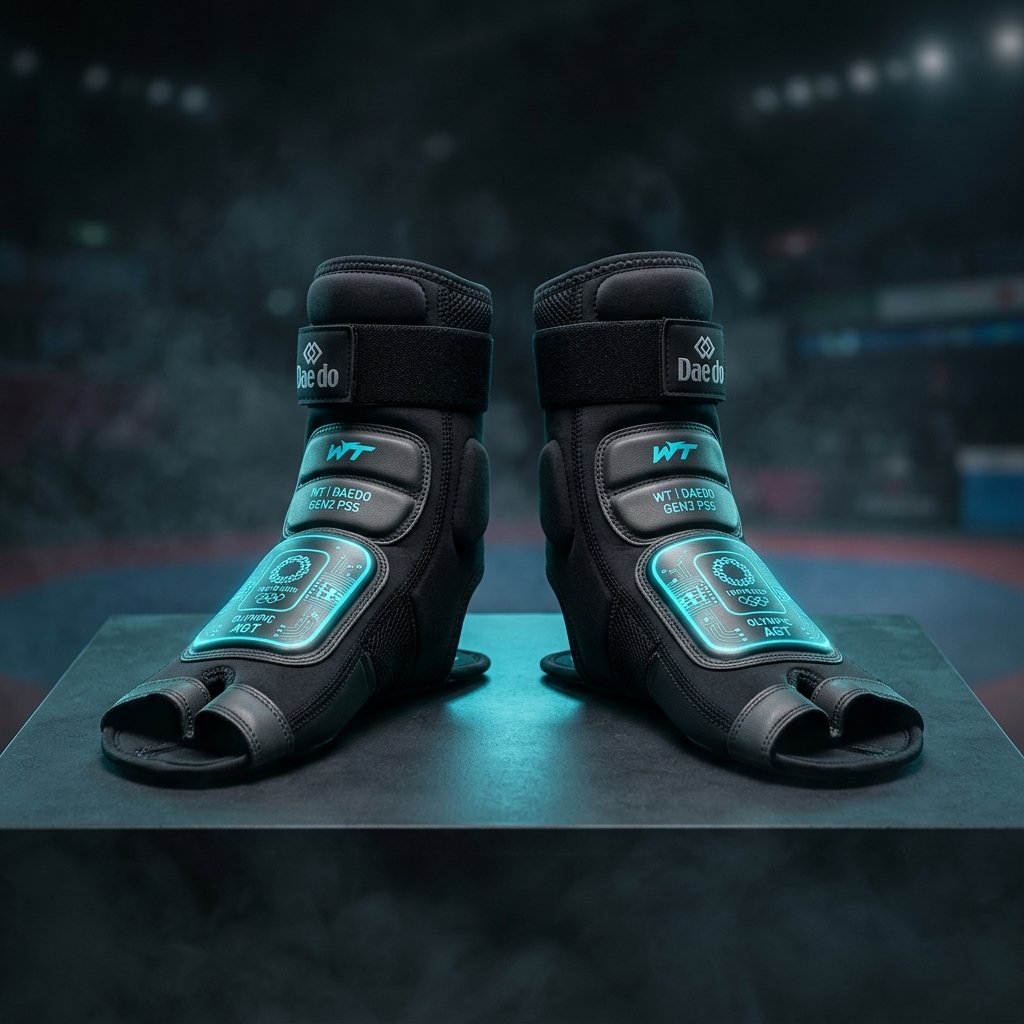
In modern tournament sparring, high velocity alone does not guarantee a score. The electronic instep sensor must dwell against the electronic hogu receiver for at least 8 to 12 milliseconds with sufficient pressure to trigger the system's threshold capacitor.
Athletes who "slap" the target with excessive whipping motion often suffer kinetic recoil before the pressure dwell time is satisfied. Elite competitors practice "penetrative follow-through," ensuring the strike decelerates only after full target displacement has occurred.
Upgrade Your Kicking Power With Sensor Sync
Connect your training sessions directly to TaekFlow's real-time velocity tracking app.